
Setting up an industrial unit or expanding a manufacturing plant in India’s commercial heartbeat is a high-stakes investment. Whether you are a multinational corporation (MNC) establishing a greenfield project or an expanding SME scaling up in major hubs like Pune, Chakan, Talegaon, and Ranjangaon, navigating regulatory permissions can feel like a labyrinth. This Step-by-Step Guide to Industrial Liaisoning & Factory Approvals in Maharashtra provides foreign investors, project heads, and plant managers with a comprehensive blueprint to streamline statutory clearances, maintain legal compliance, and guarantee operational readiness without costly delays.
Industrial expansion in Maharashtra promises access to world-class logistics networks, skilled talent, and robust infrastructure. However, navigating bureaucratic procedures across multiple government departments requires meticulous planning. From acquiring land permissions from the Maharashtra Industrial Development Corporation (MIDC) to securing pollution clearances and safety licenses, managing regulatory workflows requires localized technical expertise.
Working with professional experts simplifies statutory compliance, eliminates bureaucratic friction, and ensures a seamless transition from site acquisition to full-scale commercial production.
What is Industrial Liaisoning and Why Is It Critical in Maharashtra?
Industrial liaisoning is the strategic process of managing communications, regulatory applications, documentation, and coordination between a business entity and various state and central government authorities. In Maharashtra, setting up a manufacturing facility requires navigating multiple legal frameworks, statutory codes, and environmental regulations.
Without an organized compliance strategy, project timelines can easily derail. A single rejected floor plan or an incomplete pollution control report can cause months of delay, leading to severe financial losses.
Why Approvals Demand Local Expertise
Maharashtra operates under a dynamic multi-departmental governance model. While single-window portals like MAITRI (Maharashtra Industry, Trade and Investment Facilitation Cell) facilitate basic filings, actual plan approvals, site inspections, and operational NOCs require detailed technical submissions and active coordination with local field officers.
A specialized liaisoning strategy ensures:
- Risk Mitigation: Identifying site zoning restrictions, environmental red flags, or infrastructure limitations before committing capital.
- Capital Efficiency: Eliminating project idle time where machinery, land leases, and workforce remain unutilized waiting for permits.
- Regulatory Peace of Mind: Ensuring absolute legal validity to prevent operational shutdown orders or statutory fines during audits.
Core Pillars of Maharashtra’s Industrial Approval Framework
Before breaking ground or deploying machinery, every manufacturing facility must obtain clearances across five core statutory domains:
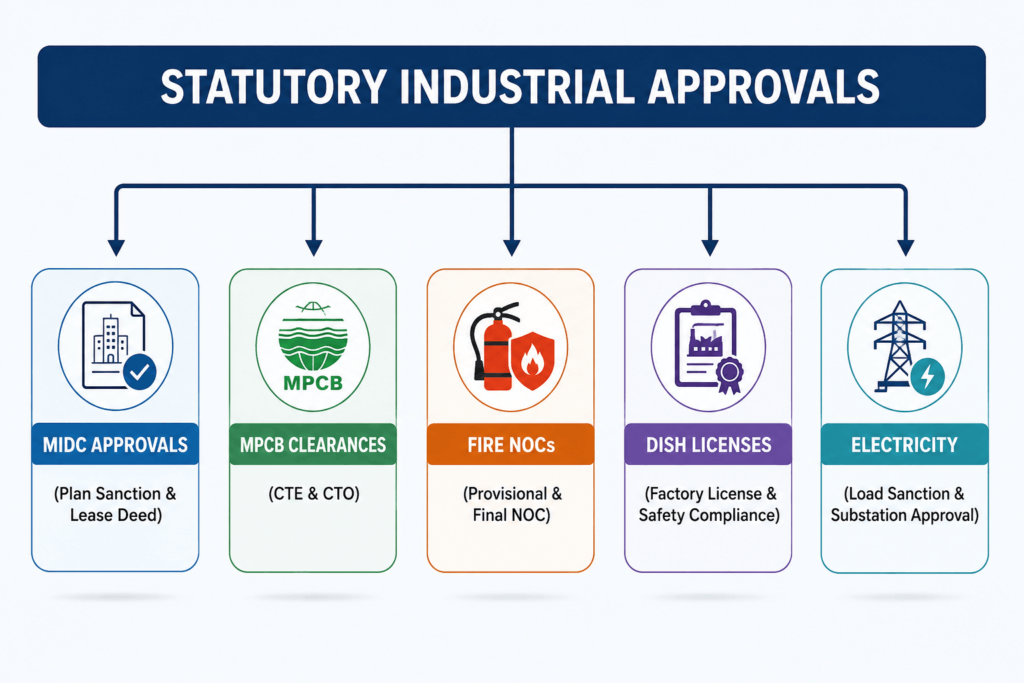
- MIDC Plan Sanctions & Allotment: Securing land allotment, lease agreements, and building architecture approval.
- MPCB Pollution Control Approvals: Obtaining Consent to Establish (CTE) and Consent to Operate (CTO).
- Fire & Life Safety Clearances: Obtaining Provisional and Final Fire No-Objection Certificates (NOC).
- DISH / Factory License: Approving plant layouts under the Factories Act, 1948 and securing the license to operate.
- Power & Infrastructure Sanctions: Securing high-tension (HT) electrical load allocations and water supply connections from MSEDCL and MIDC.
Step-by-Step Guide to Industrial Liaisoning & Factory Approvals in Maharashtra
Successfully commissioning a plant requires executing tasks across two distinct phases: Pre-Construction (Planning & Building) and Pre-Operational (Commissioning & Production).
Phase 1: Pre-Construction Approvals & Clearances
Step 1: MIDC Land Allotment & Lease Deed Execution
The first step involves securing industrial land. Investors must apply through the MIDC portal, detailing their business activities, required plot size, water consumption demands, power requirements, and employment generation forecasts. Once the allotment letter is issued, the premium must be paid, followed by the execution and registration of the MIDC Lease Deed.
Step 2: MIDC Building Plan Sanction
Before civil construction begins, structural drawings, architectural floor layouts, site development plans, and drainage diagrams must be submitted to the MIDC Special Planning Authority (SPA). These plans must strictly adhere to MIDC Development Control and Promotion Regulations (DCPR).
- Key Documents: Title clearance certificate, site survey map, structural stability certificate, architectural plans signed by an MIDC-empanelled architect, and lease deed copy.
Step 3: MPCB Consent to Establish (CTE)
The Maharashtra Pollution Control Board (MPCB) categorizes industries into Red, Orange, Green, and White categories based on their pollution potential index.
Before starting any construction work on-site, industries must obtain Consent to Establish (CTE). This process requires submitting details on raw materials, manufacturing workflows, expected effluent generation, air emissions, hazardous waste generation, and proposed treatment systems (ETP/STP).
Step 4: Provisional Fire NOC
Industrial structures—especially chemical plants, engineering units, and large warehouses—must meet strict fire safety regulations. The Maharashtra Fire Prevention and Life Safety Measures Act requires units to secure a Provisional Fire NOC from the MIDC Fire Department or Maharashtra Fire Services. This clearance specifies mandatory safety installations such as hydrant lines, sprinkler systems, smoke detectors, and fire doors.
Step 5: DISH (Factory Inspectorate) Layout Sanction
Under the Factories Act, 1948, the Directorate of Industrial Safety and Health (DISH) must evaluate and approve the factory building layout plan. DISH focuses on worker safety, ventilation, emergency exits, machine layout spacing, and occupational health hazards. Construction work should only proceed after DISH plan approval.
Phase 2: Post-Construction & Pre-Commissioning Approvals
Step 6: Building Completion Certificate (BCC) & Final Fire NOC
Once civil works are finished and fire protection systems are installed, official inspections take place:
- Fire Department Inspection: Verifies that all installations match the Provisional Fire NOC guidelines to grant the Final Fire NOC.
- MIDC SPA Inspection: Verifies structural alignment, side margins, floor space index (FSI) utilization, stormwater drainage, and parking provisions to issue the Building Completion Certificate (BCC).
Step 7: MPCB Consent to Operate (CTO)
After building completion and machinery setup—but before initiating commercial production—the unit must apply for Consent to Operate (CTO). MPCB officers conduct an on-site audit to inspect Effluent Treatment Plants (ETP), Sewage Treatment Plants (STP), stack height compliance, and hazardous waste storage enclosures before granting CTO.
Step 8: DISH Factory License & Electrical Energization
To begin commercial operations, you must secure the final operational licenses:
- Electrical Inspectorate Approval: Inspection of high-tension transformers, sub-stations, switchgear, and earthing setups to grant energization approval.
- DISH Factory License Registration: Grant of the official Factory License detailing installed horsepower and maximum worker limits.
Timeline, Documentation, and Bottleneck Analysis
Navigating approvals efficiently requires knowing realistic timelines and avoiding common application bottlenecks.
Approval Timelines and Agencies
| Statutory Approval | Regulatory Body | Typical Timeline | Validity Period |
| MIDC Building Plan Sanction | MIDC SPA | 30 – 45 Days | 2 to 3 Years |
| MPCB Consent to Establish (CTE) | MPCB | 45 – 60 Days | 5 Years (or until project completion) |
| Provisional Fire NOC | MIDC Fire Dept / MFS | 15 – 30 Days | 1 Year |
| DISH Plan Approval | DISH Maharashtra | 30 – 45 Days | Project Lifecycle |
| Building Completion Certificate | MIDC SPA | 30 – 45 Days | Lifetime |
| MPCB Consent to Operate (CTO) | MPCB | 45 – 60 Days | 1 to 5 Years (Renewable based on category) |
| Final Factory License | DISH Maharashtra | 15 – 30 Days | 1 to 10 Years (Renewable) |
Documentation Checklist for Industrial Approvals
To avoid application rejections or delays, compile a standardized master dossier containing:
- Land allotment letter, MIDC possession receipt, and registered lease deed.
- Architectural layouts, structural drawings, and site development blueprints.
- Process flowcharts, raw material safety data sheets (MSDS), and mass balance calculations.
- Water usage estimations and detailed wastewater treatment system (ETP/STP) designs.
- Electrical load calculation sheets verified by a certified electrical engineer.
- Board resolutions, company PAN/GST registrations, and authorized signatory profiles.
Common Bottleneck Delays & How to Avoid Them
- Discrepancies Between Architectural and DISH Drawings: Architectural plans often focus on spatial utilization while DISH demands strict health and safety clearances. Unsynchronized submissions lead to immediate rejections. Ensure structural designs are cross-reviewed by a safety consultant before submission.
- Incorrect MPCB Categorization: Miscalculating pollution indices or incorrectly declaring wastewater output leads to processing delays and potential penalties.
- Non-Compliant Fire Systems: Installing non-standard fire suppression equipment that violates Maharashtra Fire Services guidelines can cause inspection failures during Final Fire NOC audits.
Non-Compliance Risks and Financial Penalties
Operating without proper approvals or ignoring statutory guidelines can lead to severe legal and financial consequences.
Risks During the Construction Phase
- Stop-Work Orders: Executing civil construction without an MIDC Building Plan Sanction leads to immediate stop-work notices, heavy demolition penalties, or un-authorized structure surcharges.
- Environmental Fines: Beginning site development or excavation without an MPCB CTE can trigger legal notices under Section 33A of the Water Act and Section 31A of the Air Act, resulting in mandatory bank guarantee forfeitures.
Risks During the Operational Phase
- Power and Water Disconnections: Operating a plant without a valid MPCB Consent to Operate (CTO) empowers authorities to order immediate disconnection of electricity and water supplies.
- Prosecution of Directors: Violations under the Factories Act or state fire safety codes can lead to personal legal liability, heavy monetary penalties, or imprisonment for designated factory managers and company directors.
- Insurance Claim Invalidation: In the event of an industrial fire or accident, insurance providers will reject commercial claims if the plant lacks a valid Factory License or Final Fire NOC.
Industrial Hubs Focus: Pune, Chakan, Talegaon & Ranjangaon
Industrial clusters in Maharashtra operate within distinct local planning ecosystems:
- Chakan Industrial Area: Known as one of India’s largest automotive and manufacturing hubs, Chakan has strict environmental oversight due to high industrial density. MPCB CTE/CTO filings require precise air emission and hazardous waste management plans.
- Talegaon Industrial Belt: Popular for engineering, electronics, and heavy manufacturing, Talegaon features specific terrain challenges. Proper stormwater drainage and MIDC site planning are essential for fast plan sanctions.
- Ranjangaon MIDC: Home to major white-goods manufacturing and chemical processing hubs, Ranjangaon facilities require comprehensive fire safety infrastructure and high-power utility sanctions.
Partnering with an expert team that maintains dedicated field presence across these industrial corridors streamlines local inspections and speeds up regulatory approvals.
Streamline Your Industrial Setup with MCON India
Establishing a manufacturing facility in Maharashtra should focus on core operational setup—not bureaucratic hurdles. Navigating state regulations demands an experienced partner who understands the intricacies of local industrial governance.
MCON India delivers end-to-end industrial liaisoning and statutory approval services tailored for MNCs, foreign investors, and domestic manufacturers. From initial land acquisition and site survey down to final building completion certificates and factory licensing, MCON India offers comprehensive support under one roof.
Why Leading Global Enterprises Partner with MCON India
- Turnkey Single-Window Management: We handle all paperwork, technical drawings, and agency coordination across MIDC, MPCB, DISH, and Fire departments so your team can focus on production setup.
- Integrated Infrastructure Capabilities: Beyond liaisoning, MCON India is a trusted leader in turnkey industrial construction and high-precision PEB manufacturing solutions, ensuring your building design and statutory compliance are aligned from day one.
- Faster Time-to-Market: Our dedicated compliance specialists eliminate submission errors, prevent inspection delays, and accelerate project execution.
Avoid regulatory bottlenecks and launch your manufacturing plant on schedule. Contact the industrial development team at MCON India today to request a compliance audit and single-window liaisoning consultation.
Frequently Asked Questions (FAQs)
1. What is the difference between MPCB CTE and CTO?
Consent to Establish (CTE) is obtained before starting any physical construction on-site. It certifies that your proposed factory design, pollution control equipment, and site location conform to environmental norms. Consent to Operate (CTO) is applied for after construction and equipment setup are complete, but before starting commercial production. It permits actual industrial operations following a physical site inspection.
2. Can I start construction while my MIDC plan sanction is pending?
No. Executing civil work without a formally approved MIDC Building Plan Sanction is illegal under MIDC DCPR rules. Doing so can trigger stop-work orders, financial penalties, or mandatory structural modifications during final inspection.
3. How long is a DISH Factory License valid in Maharashtra?
A DISH Factory License can be granted or renewed for terms ranging from 1 to 10 years, depending on the fee structure and application preference submitted by the management.
4. What happens if my factory operates without a Fire NOC?
Operating without a valid Fire NOC exposes your facility to immediate closure notices from local fire authorities, invalidates commercial property insurance policies, and creates severe legal liabilities under the Maharashtra Fire Prevention and Life Safety Measures Act.
5. Does MCON India handle both industrial construction and regulatory liaisoning?
Yes. MCON India provides comprehensive turnkey solutions covering land procurement, architectural planning, factory approvals, PEB structural fabrication, and complete industrial facility construction. This integrated approach ensures complete alignment between project design and statutory requirements.