
In the modern manufacturing ecosystem, precision, dynamic structural integrity, and equipment stability serve as the foundational bedrock of operational success. Whether you are deploying heavy machinery, modular processing units, or high-capacity power generators, your equipment requires robust support assemblies to handle dynamic loads, excessive vibration, and harsh operating conditions. Choosing top-tier OEM fabrication services in India plays a decisive role in determining your overall project timeline, total operational cost, and plant safety.
Industrial skid units, custom equipment bases, and protective structural enclosures require exacting standards during fabrication. Relying on an unverified vendor often leads to severe dimensional misalignments, structural warpage during welding, coating failures, and costly field retrofitting. This comprehensive guide outlines the critical criteria, technical evaluations, and quality parameters required when choosing an industrial fabrication partner, ensuring your heavy equipment built-to-suit projects execute seamlessly from shop floor assembly to final commissioning.
1. Core Technical Capabilities Required for Industrial Skid Fabrication
When evaluating engineering partners for specialized industrial skid fabrication, initial assessments must extend beyond standard cutting and welding machinery. Modular skids host complex piping networks, high-pressure pumps, compressors, structural bases, and electrical control systems on a single rigid frame. A top-tier fabrication partner must demonstrate comprehensive engineering depth and dynamic load analysis capabilities.
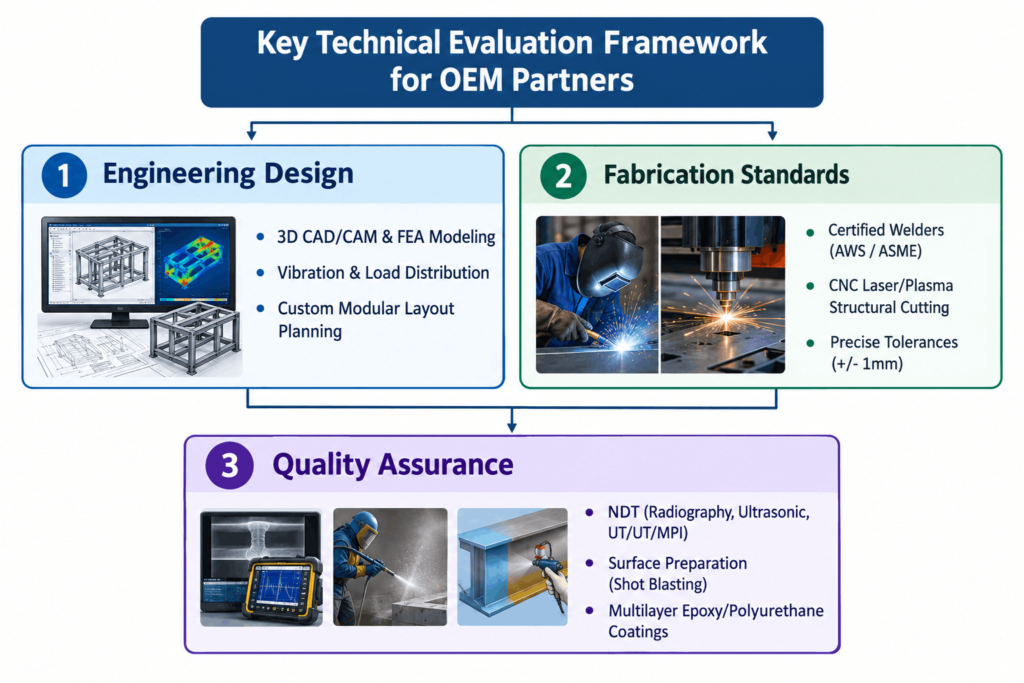
Essential Fabrication Capabilities to Verify:
- Advanced CAD/CAM and 3D Modeling Integration: Your partner must possess dedicated in-house drafting capability to translate complex engineering layouts into accurate fabrication drawings. Advanced modeling ensures clash detection between structural steel beams, piping runs, and equipment anchor points before torch ever meets metal.
- Precision Cutting and Forming Infrastructure: High-precision industrial skid fabrication requires high-capacity CNC fiber laser cutters, heavy-duty CNC plasma tables, and high-tonnage hydraulic press brakes. Precision cutting guarantees clean edge prep, uniform beveling, and consistent dimensional accuracy across multi-unit fabrication runs.
- Heavy Handling and Lifting Crane Infrastructure: Skid assemblies for heavy equipment can weigh anywhere from 5 to over 50 metric tons. Facility infrastructure must include high-capacity overhead EOT cranes, generous bay height clearances, and heavy-duty shop floor testing beds to execute smooth movement and structural load handling during assembly.
2. Material Selection & Structural Steel Fabrication Rigor
The foundation of every high-performance industrial Skid or heavy machine platform relies heavily on structural steel fabrication. The integrity of structural steel members determines how effectively a base frame absorbs high mechanical torque, suppresses resonant harmonics, and resists structural deflection under full operational weight.
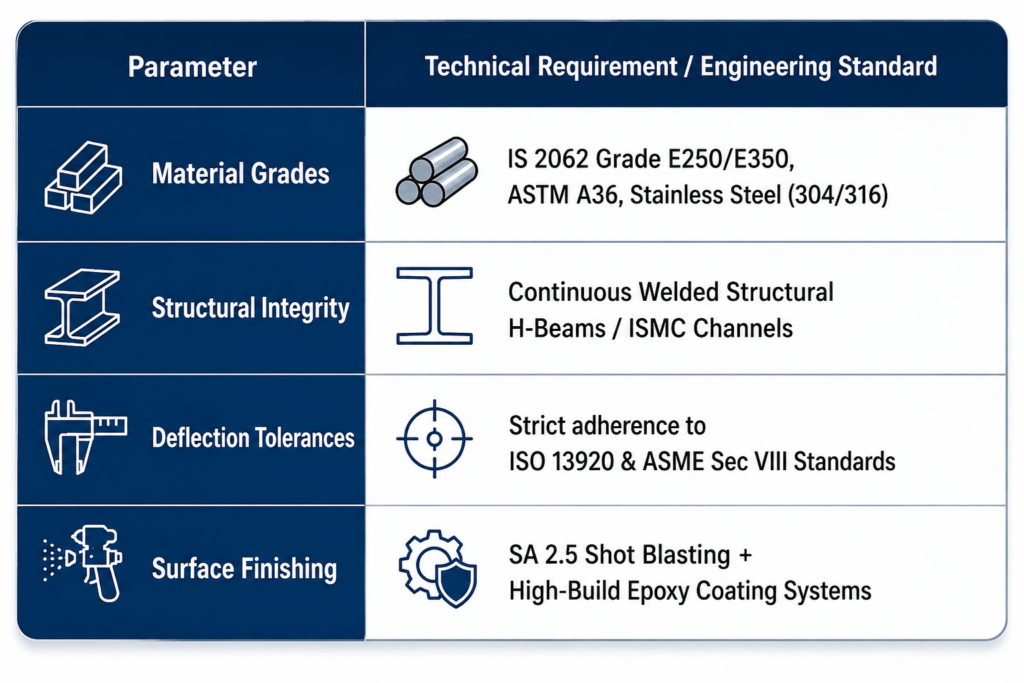
Leading base frame fabrication manufacturers utilize certified structural steel plates, structural channels (ISMC), broad H-beams, and hollow structural sections (HSS). Fabricators must perform strict raw material verification upon intake, utilizing Spectro Analysis and mill test certificates (MTCs) to prevent sub-standard structural steel from entering production lines.
Furthermore, proper thermal stress-relieving procedures, such as vibratory stress relief or heat treatment, must be applied to large base frame assemblies post-welding. Unchecked internal residual stresses lead to frame twisting, axis misalignment, and early mechanical seal failure on mounted equipment once installed at customer sites.
3. High-Precision Standards of Base Frame Fabrication Manufacturers
Base frames act as the primary structural interface between massive mechanical units (compressors, engines, hydraulic power units, or turbines) and civil concrete foundations. Precision engineering on base frames is essential to prevent operational misalignment and catastrophic bearing failures.
When evaluating elite base frame fabrication manufacturers, examine their internal machining and surface finishing infrastructure. Highly accurate base frames feature post-fabrication surface machining, where key equipment mounting pads are precision-milled using floor-type CNC boring machines to achieve absolute coplanarity and flatness across all mounting points.
Essential Base Frame Manufacturing Attributes:
- Dynamic Load and Vibration Suppression: Structural members must be reinforced with gussets, internal cross-ribbing, and mass dampening plates engineered to absorb cyclic dynamic stresses.
- Precision Equipment Mounting Holes: CNC-drilled mounting patterns ensure pin-point alignment for hold-down anchor bolts, isolating vibration and minimizing field assembly times.
- Drip Pans and Environmental Containment: Integrated fully-welded fluid containment pans (sumps) with drain plugs isolate oil or coolant leaks, ensuring environmental protection and compliance with plant safety codes.
4. Custom OEM Heavy Fabrication Capabilities and Structural Versatility
Off-the-shelf industrial enclosures and standardized steel platforms rarely meet the demands of complex, highly customized plant layouts. Selecting a partner specializing in custom OEM heavy fabrication guarantees that your final product matches precise spatial requirements, weight limits, and operational access specifications.
A fully customized manufacturing strategy accommodates integrated equipment walk-grids, heavy-duty lifting lugs calculated for precise center-of-gravity (CG) balancing, and custom multi-tiered skid configurations. Experienced structural steel fabricators adjust plate thicknesses, welding protocols, and reinforcement geometry based on structural finite element analysis (FEA) reports to deliver optimized strength-to-weight performance.
For comprehensive industrial infrastructure development—ranging from heavy machinery bases to structural buildings—collaborating with turnkey builders simplifies management across engineering, civil, and structural stages. Partnering with structural leaders like MCON India’s Industrial Construction Services unifies complete facility construction, heavy structural fabrication, and foundation setting under a single responsibility model.
5. Industrial Canopy Fabrication Cost & Protective Enclosures
Equipment operating in harsh outdoor environments—such as marine coastlines, chemical processing plants, high-dust mining regions, or extreme weather conditions—requires protective heavy enclosures. Industrial canopy fabrication protects delicate electrical control panels, gensets, and high-pressure pumping units from environmental degradation while providing acoustic attenuation.
When evaluating your overall canopy fabrication cost, look beyond initial material procurement pricing. Long-term cost-efficiency relies on overall lifecycle durability, thermal protection, acoustic performance, and rust mitigation.
Key Cost and Quality Drivers for Canopy Fabrication:
- Sheet Metal Thickness and Grade: High-grade cold-rolled close-annealed (CRCA) steel or stainless steel sheets provide structural rigidity and withstand wind loading, physical impacts, and atmospheric corrosion.
- Surface Coating & Corrosion Protection: Polyurethane paint coatings or thermosetting outdoor-grade powder coatings ensure maximum UV protection, salt-spray resistance, and chemical durability.
- Acoustic Insulation & Thermal Management: For high-noise machinery, integrated rockwool or acoustic foam lining reduces decibel emissions in compliance with central pollution board limits, while engineered ventilation louvers prevent internal equipment overheating.
6. Quality Control in Industrial Fabrication and ISO Standards
Selecting an ISO certified fabricators India option ensures your supplier operates within standardized quality management systems (such as ISO 9001:2015, ISO 3834 for fusion welding, and EN 1090 structural steel execution standards). Stringent quality control in industrial fabrication is non-negotiable when producing critical industrial skids and heavy base structures.
Essential Quality Control Metrics to Require:
- Welder Performance Qualification (WPQR): Ensure all manual welding operators and robotic stations hold valid certifications under ASME Section IX or AWS D1.1 structural welding standards.
- Non-Destructive Testing (NDT) Protocols: High-stress structural joints and pressure-retaining skid connections require comprehensive NDT verification, including Dye Penetrant Testing (DPT), Magnetic Particle Inspection (MPI), Radiographic Testing (RT), and Ultrasonic Testing (UT).
- Dimensional and Flatness Verification: Precise digital laser trackers check overall diagonal squareness, hole pitch distances, frame twist, and pad surface coplanarity down to fractions of a millimeter prior to coating application.
- Dry Film Thickness (DFT) & Adhesion Checks: Surface preparation must achieve SSPC-SP10 (SA 2.5 near-white metal blast cleaning) standards followed by digital DFT gauge measurement to verify primer, intermediate, and topcoat thickness.
For projects expanding beyond heavy equipment fabrication into full-scale modular structures, integrating pre-engineered steel components accelerates delivery. Explore how modular structural engineering streamlines overall project timelines through MCON India’s PEB Services.
7. Evaluating Manufacturing Capacity, Turnkey Infrastructure, and Compliance
Partnering with an OEM supplier requires evaluating their total manufacturing foot-print, available crane clearances, workforce skill sets, and regulatory compliance. Heavy industrial machinery setups require space for full mock-up assembly, mechanical dry runs, and complete factory acceptance testing (FAT) before shipment.
A reliable fabrication partner also delivers end-to-end statutory and regulatory support for manufacturing units. Complex industrial expansions often require local municipal permissions, environmental board approvals, and site safety clearances. Engaging with experienced service providers such as MCON India’s Regulatory Liaisoning Services keeps structural expansion fully compliant with regional land use, industrial development, and environmental laws.
Refer to standard international welding and material engineering guidelines, such as the American Welding Society (AWS) Standards and global structural steel testing specifications from the American Society for Testing and Materials (ASTM International), to ensure your partner aligns with international technical benchmarks.
Summary Checklist for Choosing Your OEM Partner
Before issuing a Purchase Order for your skid or base frame fabrication project, cross-check your prospective partner against these structural criteria:
- Do they have documented experience in OEM fabrication services in India for heavy industrial sectors?
- Can they process heavy structural beams and thick plates using automated CNC cutting, drilling, and milling equipment?
- Do certified inspectors perform in-house non-destructive testing (NDT), dimensional laser alignment checks, and surface DFT measurements?
- Are their welding operators certified to recognized standards like AWS D1.1 or ASME Section IX?
- Can their facility bay dimensions, shop floor space, and overhead crane capacities accommodate full factory acceptance testing (FAT)?
- Do they provide transparent lead times, strict cost estimates, and end-to-end material traceability through certified mill test reports (MTCs)?
Engineer Your Next Industrial OEM Project with MCON India
At MCON India, we specialize in high-precision structural steel fabrication, heavy machine base frames, customized industrial skids, and protective canopy enclosures. Operating with modern structural manufacturing facilities, advanced CNC equipment, and rigorous quality control protocols, we serve original equipment manufacturers (OEMs) and industrial leaders across diverse engineering sectors.
Whether you require custom built-to-suit industrial plant infrastructure, pre-engineered steel buildings, or heavy-duty OEM skid assemblies, our engineering team delivers precision, speed, and uncompromised quality.
Accelerate your manufacturing execution today.
Contact MCON India’s Fabrication Experts to request a technical consultation, evaluate your CAD designs, or receive a tailored project quote.
Frequently Asked Questions (Q&A)
Q1: What is the primary difference between a base frame and an industrial skid?
A base frame is a structural steel platform designed to support a specific single piece of machinery (such as a pump, engine, or compressor) and transmit its static and dynamic loads safely to a concrete foundation. An industrial skid, however, is a complete, self-contained modular processing system mounted on a heavy frame that integrates multiple components—including piping, valves, instruments, pumps, and electrical panels—allowing for simple “plug-and-play” installation at the site.
Q2: Why is post-weld stress relieving critical for heavy base frame fabrication?
Heavy welding generates localized thermal expansion and rapid cooling, introducing internal residual stresses within structural steel members. Without stress-relieving processes (such as thermal heat treatment or vibratory stress relief), these internal forces cause frame warping over time, leading to drive-shaft misalignment, excessive vibration, and premature bearing failure on mounted machinery.
Q3: How do quality control teams verify weld integrity on custom OEM heavy fabrications?
Quality assurance teams use Non-Destructive Testing (NDT) methods to inspect structural welds without damaging the component. Common techniques include Visual Testing (VT), Dye Penetrant Testing (DPT) for surface cracks, Magnetic Particle Inspection (MPI) for surface/sub-surface flaws, and Ultrasonic Testing (UT) or Radiographic Testing (RT) to inspect full-penetration structural joints.
Q4: What surface treatments offer the best corrosion resistance for outdoor industrial canopies?
For long-term outdoor protection, a multi-stage surface preparation and coating system is essential. Steel surfaces are shot-blasted to SA 2.5 standards to clean the metal and create an anchor profile. Then, a zinc-rich primer is applied, followed by a high-build epoxy intermediate coat and an outdoor-grade Polyurethane (PU) or powder-coated topcoat to withstand UV rays, moisture, and chemical exposure.
Q5: Can MCON India support custom size specifications and low-volume OEM orders?
Yes, MCON India provides tailored structural design, custom OEM heavy fabrication, and flexible production options. Whether you need bespoke prototypes, low-volume custom industrial skids, or continuous production runs of standardized base frames, our engineering team scales production to match your project requirements.